 Exciting News from Africa!
Africa Years Dear Everybody Newsletters
 Exciting News from Africa!
Africa Years Dear Everybody Newsletters
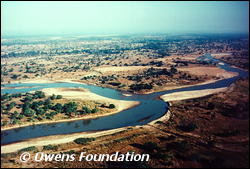 |
| North Luangwa National Park, Zambia. |
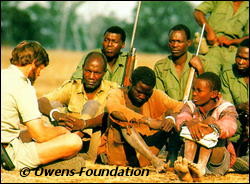 |
| Mark Owens sits with captured poachers and NLNP Game Scouts. |
At the same time, Mark and Delia selected 14 villages located near the park that were notorious for harboring commercial poachers. In fact, poaching was the primary industry in the area, providing more jobs and more sources of protein than any other. So Mark and Delia began NLCP's Community Development Program, establishing small sustainable businesses which provided basic goods and services to the local people and alternative legal jobs to poachers. This program was not a handout. Each business was run as a free enterprise, and the entrepreneur had to repay his initial start-up loan, so that the project could then help others start their own businesses. In this way, NLCP supplanted an illicit economy based on poaching with a legal one, thereby undercutting large-scale commercial poachers who hired hunters and carriers from the villages.
In the past, many villagers traded poached meat for ground maize, their staple diet. NLCP helped them form "wildlife clubs," which used NLCP business loans to purchase and run grinding mills, offering employment to millers, mechanics, and bookkeepers. In some villages these same clubs also used loans to open small general stores, which sold soap, salt, matches, and other basic commodities that people formerly could purchase only by walking days to Mpika and other towns along the main Cape-to-Cairo Road. Villagers also traded poached meat for cooking oil, a much prized commodity in rural Africa. As an alternative, NLCP taught them to grow sunflower seeds and press them for oil using simple hydraulic presses, once again replacing poaching with a sustainable legal trade. Other cottage industries that provided jobs, food, or services to the local people were carpentry shops, fish farms, poultry units, bee keeping, sewing coops, rat trap makers, and cobbler shops. NLCP also assisted subsistence farmers with seed loans, transportation and technical assistance to help them grow protein-rich crops with better yields so they did not have to depend on meat from wild animals. More than 2,000 families in the NLCP target area benefited from NLCP's Community Development and Agricultural Assistance Programs.
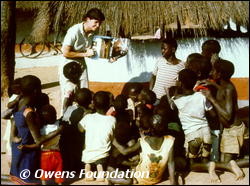 |
| Delia Owens shows village children their first color picture. |
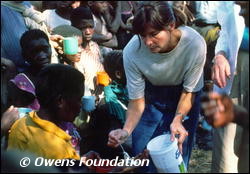 |
| Delia Owens - Rural Health Demonstration - how to mix "rehydration solution" to treat dehydration. |
The ultimate goal of NLCP was to ensure the development of a low-impact tourism industry for the North Luangwa National Park, an industry that would provide employment opportunities and development revenues for villagers who would otherwise depend on NLCP or poaching for their livelihood. Mark and Delia worked with the government to design an enviro-friendly tourism development plan for the park.
The North Luangwa Conservation Project was remarkably successful. When Mark and Delia arrived in 1986, 1,000 elephants were being poached every year. From September of 1994 to May of 1997, not one was killed in the Project area. For the first time in 20 years the elephant population of NLNP increased slightly, and villagers reported elephants, buffalo, hippos, and other large mammals in areas where they have not been seen for two, even three decades. Wildlife research and ecological monitoring documented the recovery of the elephants and other animal populations. Thirty-five elephants were collared with radio transmitters and aircraft were used to chart their range movements, habitat utilization, group size, social structure, and reproductive success.
The people near North Luangwa no longer had to poach, or collaborate with commercial poachers to feed their families. The heads of more than 2,000 families, many of whom were once involved with poaching, had legal, sustainable jobs. Leaders from villages beyond the NLCP area began asking how to start NLCP programs. NLCP has been declared a model for integrated rural development using techniques that involve nonconsumption of wildlife resources.
In 1997, Delia and Mark Owens turned over their eleven year research and conservation project in North Zambia to the Frankfurt Zoological Society of Germany. Several months later, FZS determined that they could only afford to continue Delia and Mark's Research and Anti-Poaching work but could not afford to continue to fund the Village Outreach Programs initiated by the Owenses. But, the two Zambian men who had headed Small Business Development and Agriculture Assistance under Delia and Mark's directorship determined that they would remain in Mpika and continue these programs on their own.
Hammer Simwinga (Agriculture Assistance) and Albert Chilambwe (Small Business Development) have done a wonderful job and with very little outside assistance. Delia and Mark believe that they have proven themselves and deserve our help. We are so pleased to announce that we are once again supporting the Village Outreach initiatives that Delia and Mark established between 1986 and 1997 by providing grants to Hammer and Albert's non-profit organization, The North Luangwa Wildlife Conservation and Community Development Project. Our first grant is for the establishment of Bee Keeping industries in the villages of Mukungule and Nabwalya. Hammer and Albert have determined that these two villages are experiencing the greatest impact from the recovering wildlife populations of North Luangwa and will benefit most from the Bee Keeping project.
Hammer and Albert will identify ten business people in each village who will receive loans to establish aviaries which will be located along water concourses and near agriculture fields so that the bees will facilitate crop pollination. Once these first twenty aviaries have been colonized and are producing honey, Hammer and Albert will identify ten more potential business people in each village. The loans for the establishment of the Bee Keeping industries will be repaid over a two year period to a revolving fund which will then generate funds for additional business and agriculture projects. This repayment schedule allows each business person to make a profit and repay their loan in a reasonable time frame. Hammer and Albert will provide each loan recipient with business training as well as with technical assistance in Bee Keeping. Once forty Bee Keepers are in business, Hammer and Albert will establish a Bee Keeper's Association so the business men and women can share information on improving their work.
The Owens Foundation is also providing some small scale support for the Traditional Birth Attendants trained by Delia and Mark's Rural Health Program to improve the health of the people living near the Park. Hammer and Albert will work with a Registered Nurse who lives in Mpika to conduct a refresher course for the TBA's. The first shipment of medical supplies has been made to restock the TBA first aid kits.
It is our hope that we will also be able to provide support for continuing Conservation Education in the schools near North Luangwa.
As the ring of human prosperity continues to grow around North Luangwa National Park, the wildlife there will be less and less threatened by poachers. The village people living near the park will not need to poach to feed their families or to work for commercial poachers to raise money. They will continue to have sustainable businesses and agriculture and an improved quality of life. The people and the wildlife of North Luangwa can coexist and tourists from all over the world can come to see this beautiful place, its people and its wildlife.
| Click here for Photo Essay! |
